
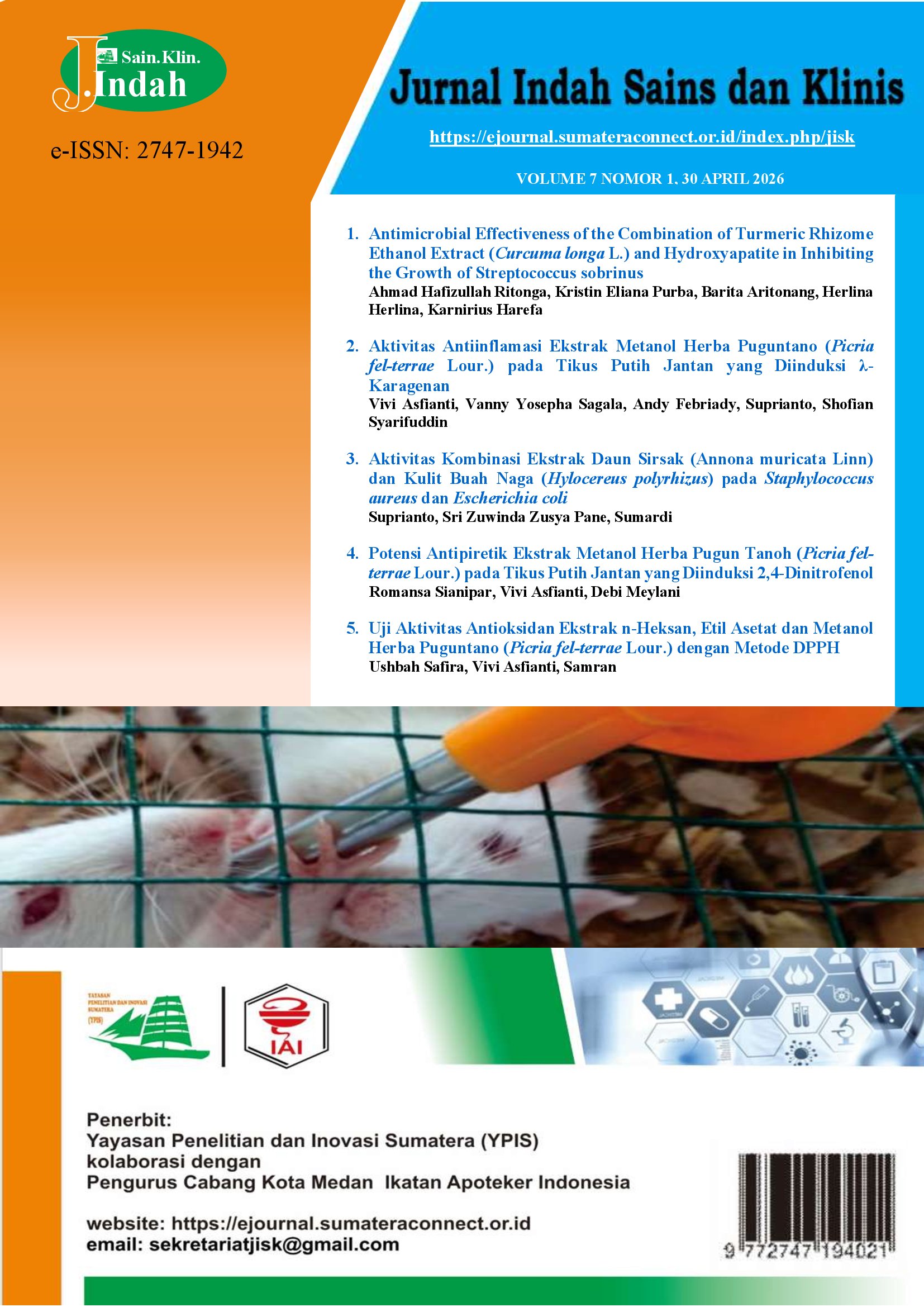
Aktivitas Antiinflamasi Ekstrak Metanol Herba Puguntano (Picria fel-terrae Lour.) pada Tikus Putih Jantan yang Diinduksi λ-Karagenan
DOI:
https://doi.org/10.52622/jisk.v7i1.02Keywords:
anti-inflammatory activity, Picria fel-terrae Lour, methanolic exttract, λ-carrageenan, paw edema, male white ratsAbstract
Background: Inflammation is a normal protective response to tissue injury caused by physical trauma, chemical exposure, or microbial agents. When excessive, this response may worsen tissue damage and require treatment. Interest in medicinal plants as alternative anti-inflammatory agents remains high because conventional nonsteroidal anti-inflammatory drugs, although effective, may cause adverse effects. Puguntano herb (Picria fel-terrae Lour.) contains flavonoids, saponins, tannins, glycosides, and steroids or triterpenoids that may contribute to anti-inflammatory activity. Objective: This study aimed to evaluate the anti-inflammatory effect of the methanolic extract of puguntano herb in male white rats with λ-carrageenan-induced paw edema and to identify the most effective tested dose. Methods: An experimental design was used in twenty-five healthy male rats divided into five groups. The negative control received 0.5% Na-CMC, the positive control received sodium diclofenac 2.25 mg/kg body weight, and the treatment groups received extract doses of 50, 100, and 200 mg/kg body weight. Acute inflammation was induced by intraplantar injection of 1% λ-carrageenan. Paw volume was measured with a digital plethysmometer for 360 minutes. Percentage of inflammation and percentage of inhibition were analyzed using one-way ANOVA followed by Tukey’s test. Results: The methanolic extract showed anti-inflammatory activity at all tested doses. A dose-dependent pattern was observed, with greater edema suppression at higher doses. The 200 mg/kg body weight dose produced the strongest effect and showed activity comparable to sodium diclofenac. Conclusion: The methanolic extract of puguntano herb demonstrated anti-inflammatory potential in this model, with the 200 mg/kg body weight dose as the most effective treatment for further preclinical study
Downloads
References
J. M. Al-Khayri, G. R. Sahana, P. Nagella, B. V Joseph, F. M. Alessa, and M. Q. Al-Mssallem, “Flavonoids as Potential Anti-inflammatory Molecules: A Review,” Molecules, vol. 27, no. 9, p. 2901, 2022. DOI: https://doi.org/10.3390/molecules27092901
J. A. Giménez-Bastida, A. Gonzalez-Sarrias, J. M. Laparra-Llopis, C. Schneider, and J. C. Espín, “Targeting Mammalian 5-lipoxygenase by Dietary Phenolics as An Anti-inflammatory Mechanism: A Systematic Review,” Int. J. Mol. Sci., vol. 22, no. 15, p. 7937, 2021. DOI: https://doi.org/10.3390/ijms22157937
M. Lončarić, I. Strelec, T. Moslavac, D. Šubarić, V. Pavić, and M. Molnar, “Lipoxygenase Inhibition by Plant Extracts,” Biomolecules, vol. 11, no. 2, p. 152, 2021. DOI: https://doi.org/10.3390/biom11020152
S. Bindu, S. Mazumder, and U. Bandyopadhyay, “Non-steroidal Anti-inflammatory Drugs (NSAIDs) and Organ Damage: A Current Perspective,” Biochem. Pharmacol., vol. 180, p. 114147, 2020. DOI: https://doi.org/10.1016/j.bcp.2020.114147
T. Yimer, E. M. Birru, M. Adugna, M. Geta, and Y. K. Emiru, “Evaluation of Analgesic and Anti-inflammatory Activities of 80% Methanol Root Extract of Echinops kebericho M.(Asteraceae),” J. Inflamm. Res., vol. 2020, no. 13, pp. 647–658, 2020. DOI: https://doi.org/10.2147/JIR.S267154
B. Olela, J. Mbaria, T. Wachira, and G. Moriasi, “Acute oral Toxicity and Anti‐inflammatory and Analgesic Effects of Aqueous and Methanolic Stem Bark Extracts of Piliostigma thonningii (Schumach.),” Evidence‐Based Complement. Altern. Med., vol. 2020, no. 1, p. 5651390, 2020. DOI: https://doi.org/10.1155/2020/5651390
T. F. Belachew, S. Asrade, M. Geta, and E. Fentahun, “In Vivo Evaluation of Wound Healing and Anti‐inflammatory Activity of 80% Methanol Crude Flower Extract of Hagenia abyssinica (Bruce) JF Gmel in Mice,” Evidence‐Based Complement. Altern. Med., vol. 2020, p. 9645792, 2020. DOI: https://doi.org/10.1155/2020/9645792
E. Ashenafi, T. Abula, S. M. Abay, M. Arayaselassie, S. Taye, and R. A. Muluye, “Analgesic and Anti-inflammatory Effects of 80% Methanol Extract and Solvent Fractions of The Leaves of Vernonia auriculifera hiern.(Asteraceae),” J. Exp. Pharmacol., vol. 15, pp. 29–40, 2023. DOI: https://doi.org/10.2147/JEP.S398487
M. Arega, A. Nardos, A. Debella, B. Dereje, L. Terefe, and A. Abebe, “Evaluation of Anti-inflammatory Activity of The Methanol Extracts of Premna schimperi Engl (Lamiaceae) Leaves in Rats,” J. Exp. Pharmacol., vol. 15, pp. 437–447, 2023. DOI: https://doi.org/10.2147/JEP.S432615
R. F. Utama, “Immunomodulator Activity of Puguntano (Picria fel-terrae Lour.) Extract in White Male Mice by Carbon Clearance Method,” Indones. J. Pharm. Clin. Res., vol. 3, no. 2, pp. 19–24, 2020. DOI: https://doi.org/10.32734/idjpcr.v3i2.4306
A. Ningtias, “Poguntano Herba Extract Immunostimulant Activities (Picriafel-terraeLour). in Immunosupression Rats Infected by Staphylococcus aureus Against Total Leukocytes and Differential Leukocytes,” Indones. J. Pharm. Clin. Res., vol. 4, no. 1, pp. 39–46, 2021. DOI: https://doi.org/10.32734/idjpcr.v4i1.5378
Y. Yuandani et al., “Immunomodulatory Effects of Combined Ethanol Extracts of Curcuma mangga and Picria fel-terrae on Cellular‐and Humoral‐Mediated Immunity in Wistar Rats and Mice,” Evidence‐Based Complement. Altern. Med., vol. 2022, no. 1, p. 1791165, 2022. DOI: https://doi.org/10.1155/2022/1791165
A. Dalimunthe, D. Pertiwi, M. Muhmmad, V. E. Kaban, N. Nasri, and D. Satria, “The Effect of Extraction Methods Towards Antioxidant Activity of Ethanol Extract of Picria fel-terrae Lour. Herbs,” in IOP Conference Series: Earth and Environmental Science, IOP Publishing, 2022, p. 12040. DOI: https://doi.org/10.1088/1755-1315/1115/1/012040
L. Xiang, Q. Huang, T. Chen, Q. He, H. Yao, and Y. Gao, “Ethanol Extract of Paridis rhizoma Attenuates Carrageenan-Induced Paw Swelling in Rats by Inhibiting The Production of Inflammatory Factors,” BMC Complement. Med. Ther., vol. 23, no. 1, p. 437, 2023. DOI: https://doi.org/10.1186/s12906-023-04264-6
M. Cordaro et al., “Cashew (Anacardium occidentale L.) Nuts Counteract Oxidative Stress and Inflammation in An Acute Experimental Model of Carrageenan-Induced Paw Edema,” Antioxidants, vol. 9, no. 8, p. 660, 2020. DOI: https://doi.org/10.3390/antiox9080660
E. H. Krishna, K. S. Saravanan, and J. Jays, “Ziziphus rugosa Leaf: Pharmacognostical Characters and Anti-Inflammatory Properties against Carrageenan-Induced Paw Edema,” Borneo J. Pharm., vol. 7, no. 1, pp. 89–103, 2024. DOI: https://doi.org/10.33084/bjop.v7i1.6411
A. Renny et al., “Methanol Extract of Thottea siliquosa (Lam.) Ding Hou Leaves Inhibits Carrageenan-and Formalin-Induced Paw Edema in Mice,” Molecules, vol. 29, no. 20, p. 4800, 2024. DOI: https://doi.org/10.3390/molecules29204800
V. Mayakrishnan et al., “Chemical Composition Analysis and Assessment of Antioxidant and Anti-inflammatory Activities of Crude Extract of Flueggea leucopyrus on Carrageenan-Induced Paw Edema in Wistar Albino Rats,” Antioxidants, vol. 13, no. 8, p. 976, 2024. DOI: https://doi.org/10.3390/antiox13080976
E. S. Mohd Ramli, N. M. Tarmizi, N. A. Kamaruddin, and M. A. Kamaruzzaman, “Lepisanthes alata Attenuates Carrageenan-Induced Inflammation and Pain in Rats: A Phytochemical-Based Approach,” Pharmaceuticals, vol. 18, no. 8, p. 1142, 2025. DOI: https://doi.org/10.3390/ph18081142
N. Percie du Sert et al., “The Arrive guidelines 2.0: Updated Guidelines for Reporting Animal Research,” J. Cereb. Blood Flow Metab., vol. 40, no. 9, pp. 1769–1777, 2020. DOI: https://doi.org/10.1177/0271678X20943823
Downloads
Published
Issue
Section
License
Copyright (c) 2026 Jurnal Indah Sains dan Klinis

This work is licensed under a Creative Commons Attribution-NonCommercial-ShareAlike 4.0 International License.
Copyright © The Author(s). This article is licensed under a Creative Commons Attribution-NonCommercial-ShareAlike 4.0 International License (CC BY-NC-SA 4.0).




 This work is licensed under a