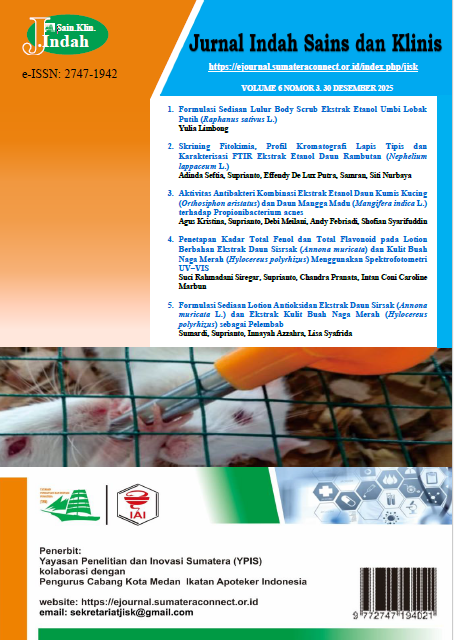
Formulasi Sediaan Lotion Antioksidan Ekstrak Daun Sirsak (Annona muricata L.) dan Ekstrak Kulit Buah Naga Merah (Hylocereus polyrhizus) sebagai Pelembab
DOI:
https://doi.org/10.52622/jisk.v6i3.05Kata Kunci:
Sirsak, Naga Merah, lotion, moisturizing, antioxidantAbstrak
Background: A lotion made from ethanol extracts of Sirsak (Annona muricata) leaves and Naga Merah fruit (Hylocereus polyrhizus) peels is a potential antioxidant moisturizer, but its quality, safety, and hydration effect need confirmation. Objective: To formulate five oil-in-water lotions with different extract ratios (total extract 3% w/w) and evaluate physical quality, preliminary safety, and moisturizing performance. Method: The formulations were tested for organoleptic properties, homogeneity, pH, and spreadability. A simple irritation test and a three-day forearm hydration assessment using a skin analyzer were conducted in 25 panelists, followed by one-way analysis of variance. Results: All formulations had pH 6.67–6.96, with minor inhomogeneity observed in one formulation. Acceptable spreadability was achieved by three formulations under specific loads. No irritation occurred. All formulations increased hydration, with significant differences between them (p < 0.001); the two best-performing formulations produced the highest and most stable moisture over three days. Conclusion: The combined-extract oil-in-water lotion at 3% w/w is feasible and preliminarily safe, and the two top formulations are recommended for further development
Unduhan
Referensi
M. Wei, X. He, N. Liu, and H. Deng, “Role of Reactive Oxygen Species in Ultraviolet-Induced Photodamage of The Skin,” Cell Div., vol. 19, no. 1, p. 1, 2024. DOI: https://doi.org/10.1186/s13008-024-00107-z
B. E. Kim et al., “Particulate Matter Causes Skin Barrier Dysfunction,” JCI insight, vol. 6, no. 5, p. e145185, 2021. DOI: https://doi.org/10.1172/jci.insight.145185
N. H. Amin Hussen, S. K. Abdulla, N. M. Ali, V. A. Ahmed, A. H. Hasan, and E. E. Qadir, “Role of Antioxidants in Skin Aging and The Molecular Mechanisms of ROS: A Comprehensive Review,” Asp. Mol. Med., p. 100063, 2025. DOI: https://doi.org/10.1016/j.amolm.2025.100063
M. Michalak, “Plant Extracts as Skin Care and Therapeutic Agents,” Int. J. Mol. Sci., vol. 24, no. 20, p. 15444, 2023. DOI: https://doi.org/10.3390/ijms242015444
M. Green, N. Kashetsky, A. Feschuk, and H. I. Maibach, “Transepidermal Water Loss (TEWL): Environment and Pollution—A Systematic Review,” Ski. Heal. Dis., vol. 2, no. 2, pp. ski2-104, 2022. DOI: https://doi.org/10.1002/ski2.104
D. Kundu, A. Jayaraman, and C. K. Sen, “Clinical Measurement of Transepidermal Water Loss,” Adv. Wound Care, 2025. DOI: https://doi.org/10.1089/wound.2024.0148
N. Madnani et al., “Revitalizing The Skin: Exploring The Role of Barrier Repair Moisturizers,” J. Cosmet. Dermatol., vol. 23, no. 5, pp. 1533–1540, 2024. DOI: https://doi.org/10.1111/jocd.16171
S. M. Mawazi et al., “A Review of Moisturizers; History, Preparation, Characterization and Applications,” Cosmetics, vol. 9, no. 3, p. 61, 2022. DOI: https://doi.org/10.3390/cosmetics9030061
A. Z. M. Badruddoza, T. Yeoh, J. C. Shah, and T. Walsh, “Assessing and Predicting Physical Stability of Emulsion-Based Topical Semisolid Products: A Review,” J. Pharm. Sci., vol. 112, no. 7, pp. 1772–1793, 2023. DOI: https://doi.org/10.1016/j.xphs.2023.03.014
S. N. Zubaidi et al., “Annona muricata: Comprehensive Review on the Ethnomedicinal, Phytochemistry, and Pharmacological Aspects Focusing on Antidiabetic Properties,” Life, vol. 13, no. 2, p. 353, 2023. DOI: https://doi.org/10.3390/life13020353
D. F. Nishikito et al., “Anti-Inflammatory, Antioxidant, and Other Health Effects of Dragon Fruit and Potential Delivery Systems for Its Bioactive Compounds,” Pharmaceutics, vol. 15, no. 1, p. 159, 2023. DOI: https://doi.org/10.3390/pharmaceutics15010159
N. L. Le, “Functional Compounds in Dragon Fruit Peels and Their Potential Health Benefits: A Review,” Int. J. Food Sci. Technol., vol. 57, no. 5, pp. 2571–2580, 2022. DOI: https://doi.org/10.1111/ijfs.15111
W. Tang et al., “Phenolic Compounds Profile and Antioxidant Capacity of Pitahaya Fruit Peel from Two Red-Skinned Species (Hylocereus polyrhizus and Hylocereus undatus),” Foods, vol. 10, no. 6, p. 1183, 2021. DOI: https://doi.org/10.3390/foods10061183
X. Jin, M. Imran, and Y. Mohammed, “Topical Semisolid Products—Understanding the Impact of Metamorphosis on Skin Penetration and Physicochemical Properties,” Pharmaceutics, vol. 14, no. 11, p. 2487, 2022. DOI: https://doi.org/10.3390/pharmaceutics14112487
N. Oliveira, M. de la L. Cádiz-Gurrea, A. M. Silva, C. Macedo, F. Rodrigues, and P. Costa, “Development and Optimization of a Topical Formulation with Castanea sativa Shells Extract Based on the Concept ‘Quality by Design,’” Sustainability, vol. 14, no. 1, p. 129, 2021. DOI: https://doi.org/10.3390/su14010129
E. Y. Al-Barghouthy, S. Hamed, G. F. Mehyar, and H. S. AlKhatib, “Comparative Evaluation of Spreadability Measurement Methods for Topical Semisolid Formulations/A Scoping Review,” Gels, vol. 11, no. 12, p. 1006, 2025. DOI: https://doi.org/10.3390/gels11121006
M. Na, G. Ritacco, D. O’Brien, M. Lavelle, A. M. Api, and D. Basketter, “Fragrance Skin Sensitization Evaluation and Human Testing: 30-Year Experience,” Dermatitis, vol. 32, no. 5, pp. 339–352, 2021. DOI: https://doi.org/10.1097/DER.0000000000000684
I. M. Gidado, M. Qassem, I. F. Triantis, and P. A. Kyriacou, “Review of Advances in the Measurement of Skin Hydration Based on Sensing of Optical and Electrical Tissue Properties,” Sensors, vol. 22, no. 19, p. 7151, 2022. DOI: https://doi.org/10.3390/s22197151
J. H. Park et al., “Skin Hydration Measurement: Comparison Between Devices and Clinical Evaluations,” Ann. Dermatol., vol. 36, no. 5, p. 275, 2024. DOI: https://doi.org/10.5021/ad.23.103
C. E. Agbangba, E. S. Aide, H. Honfo, and R. G. Kakai, “On The Use of Post-Hoc Tests in Environmental and Biological Sciences: A Critical Review,” Heliyon, vol. 10, no. 3, 2024. DOI: https://doi.org/10.1016/j.heliyon.2024.e25131
M. C. Restrepo-Zapata, P. A. Chacón-Pabón, E. Montoya-Henao, D. T. Muñoz-Castiblanco, and J. C. Mejía-Giraldo, “Optimized Extraction of Passiflora ligularis Pectins: Characterization and Application in Moisturizing Cosmetic Products,” Cosmetics, vol. 12, no. 6, p. 261, 2025. DOI: https://doi.org/10.3390/cosmetics12060261
V. H. P. Infante, M. E. Darvin, and P. M. B. G. Maia Campos, “Characterization and Efficacy of Essential Oil-Based Cosmetic Formulations for Acne-Prone Skin,” Cosmetics, vol. 10, no. 6, p. 158, 2023. DOI: https://doi.org/10.3390/cosmetics10060158
A. Prommaban and W. Chaiyana, “Microemulsion of Essential oils from Citrus Peels and Leaves with Anti-aging, Whitening, and Irritation Reducing Capacity,” J. Drug Deliv. Sci. Technol., vol. 69, p. 103188, 2022. DOI: https://doi.org/10.1016/j.jddst.2022.103188
N. Linares-Devia, J. Arrieta-Escobar, Y. Baena, A. Orjuela, and C. Osorio, “Development and Characterization of Emulsions Containing Ground Seeds of Passiflora Species as Biobased Exfoliating Agents,” Cosmetics, vol. 9, no. 1, p. 15, 2022. DOI: https://doi.org/10.3390/cosmetics9010015
M. Lukić, I. Pantelić, and S. D. Savić, “Towards Optimal pH of the Skin and Topical Formulations: From the Current State of the Art to Tailored Products,” Cosmetics, vol. 8, no. 3, p. 69, 2021. DOI: https://doi.org/10.3390/cosmetics8030069
S.-H. Kuo, C.-J. Shen, C.-F. Shen, and C.-M. Cheng, “Role of pH Value in Clinically Relevant Diagnosis,” Diagnostics, vol. 10, no. 2, p. 107, 2020. DOI: https://doi.org/10.3390/diagnostics10020107
S. Bom, L. F. Gouveia, P. Pinto, A. M. Martins, H. M. Ribeiro, and J. Marto, “A Mathematical Modeling Strategy to Predict The Spreading Behavior on Skin of Sustainable Alternatives to Personal Care Emollients,” Colloids Surfaces B Biointerfaces, vol. 205, p. 111865, 2021. DOI: https://doi.org/10.1016/j.colsurfb.2021.111865
A. A. Az-Zahra, R. Asra, and U. Lestari, “Formulation and Stability Testing of Physical Properties of Sunscreen from Dragon’s Blood Resin (Daemonorops draco (Willd.) Blume),” Ris. Inf. Kesehat., vol. 14, no. 2, pp. 348–356, 2025. DOI: https://doi.org/10.30644/rik.v14i2.1023
M. Portugal‐Cohen et al., “Requirements for Alternative In Vitro and In Silico Skin Models of Irritant and Allergic Contact Dermatitis,” Contact Dermatitis, 2025. DOI: https://doi.org/10.1111/cod.14815
A. Goldenberg, A. Ehrlich, B. C. Machler, and S. E. Jacob, “Patch Test Clinic Start-up: From Basics to Pearls,” Dermatitis, vol. 31, no. 5, pp. 287–296, 2020. DOI: https://doi.org/10.1097/DER.0000000000000559
P. Matarrese, G. Beauchef, L. Peno-Mazzarino, E. Lati, R. Fitoussi, and K. Vié, “Assessment of an Ex Vivo Irritation Test Performed on Human Skin Explants and Comparison of Its Results With Those of a 24-/48-h Human Patch Test for the Evaluation of Cosmetics,” Toxicol. Vitr., vol. 70, p. 105030, 2021. DOI: https://doi.org/10.1016/j.tiv.2020.105030
T. V. A. Westermann, V. R. Viana, C. Berto Junior, C. B. Detoni da Silva, E. L. S. Carvalho, and C. G. Pupe, “Measurement of Skin Hydration with a Portable Device (SkinUp® Beauty Device) and Comparison with The Corneometer®,” Ski. Res. Technol., vol. 26, no. 4, pp. 571–576, 2020. DOI: https://doi.org/10.1111/srt.12833
M. Morin et al., “Skin Hydration Dynamics Investigated by Electrical Impedance Techniques in Vivo and in Vitro,” Sci. Rep., vol. 10, no. 1, p. 17218, 2020. DOI: https://doi.org/10.1038/s41598-020-73684-y
S. Rohmani, S. K. Ningrum, W. D. Wardhani, and W. Kundarto, “Pengaruh Variasi Konsentrasi Surfaktan Iselux Ultra Mild pada Formulasi Hydrating Facial Wash Potassium Azeloyl Diglycinate,” J. Kefarmasian Indones., pp. 58–68, 2022. DOI: https://doi.org/10.22435/jki.v0i0.4969
M. P. Mahardika, P. O. Riyan, and M. V. V. Nika, “Formulation and Stability Evaluation of Carrot Extract (Daucus carota L.) Scrub Lotion as a Natural Moisturizer,” J. Syifa Sci. Clin. Res., vol. 7, no. 3, pp. 264–274, 2025. DOI: https://doi.org/10.37311/jsscr.v7i3.33398
A. Samadi, S. Ahmad Nasrollahi, M. Maghsoudi Ashtiani, C. Abels, and A. Firooz, “Changes in Skin Barrier Function Following Single and Repeated Applications of 4 Types of Moisturizers: a Randomized Controlled Trial,” J. Eur. Acad. Dermatology Venereol., vol. 34, no. 6, 2020. DOI: https://doi.org/10.1111/jdv.16288
J. Rajkumar, N. Chandan, P. Lio, and V. Shi, “The Skin Barrier and Moisturization: Function, Disruption, and Mechanisms of Repair,” Skin Pharmacol. Physiol., vol. 36, no. 4, pp. 174–185, 2023. DOI: https://doi.org/10.1159/000534136
Unduhan
Diterbitkan
Terbitan
Bagian
Lisensi
Hak Cipta (c) 2025 Jurnal Indah Sains dan Klinis

Artikel ini berlisensiCreative Commons Attribution-NonCommercial-ShareAlike 4.0 International License.
Copyright © The Author(s). This article is licensed under a Creative Commons Attribution-NonCommercial-ShareAlike 4.0 International License (CC BY-NC-SA 4.0).




 This work is licensed under a