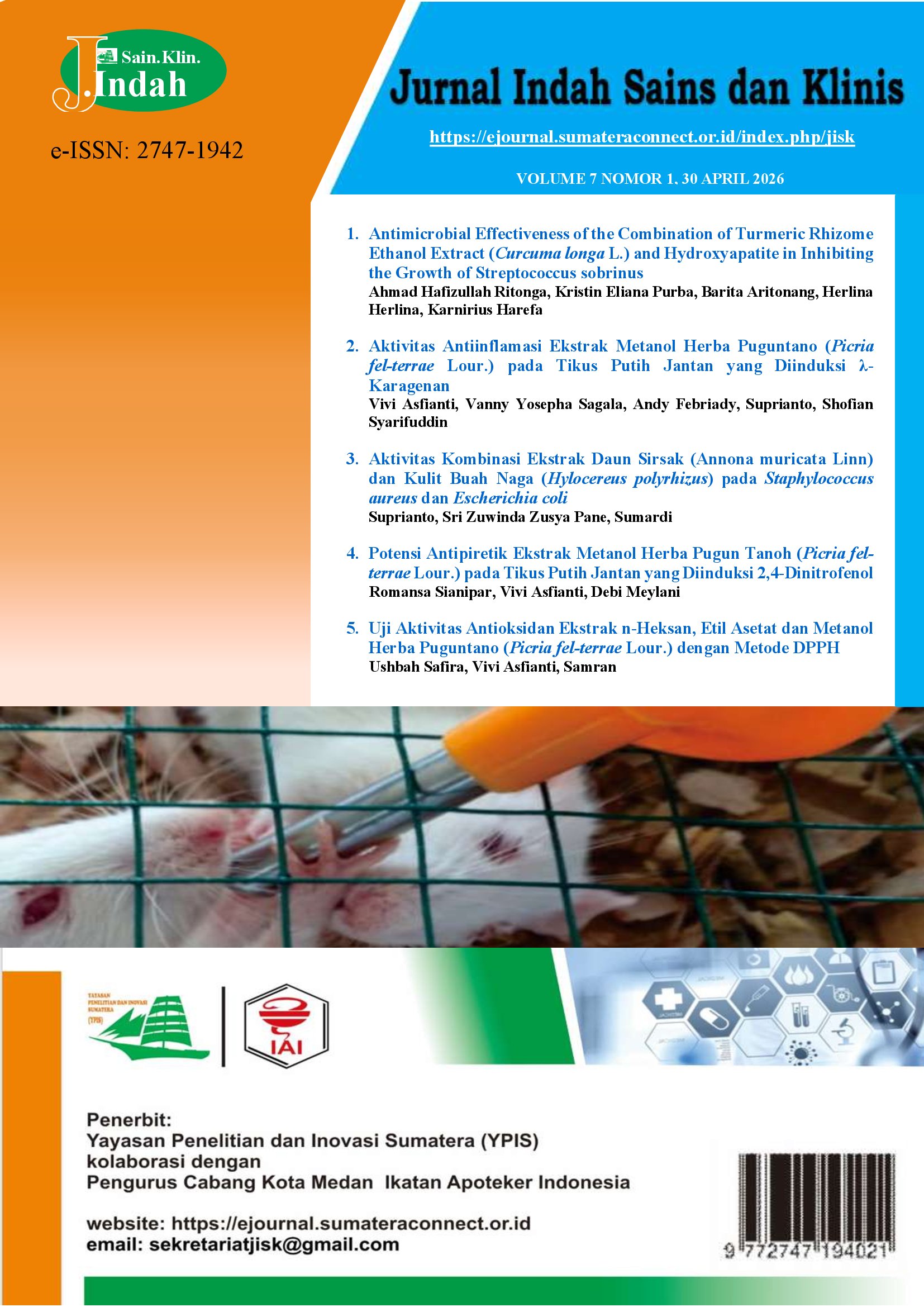
Efektivitas Antimikroba Kombinasi Ekstrak Etanol Rimpang Kunyit (Curcuma longa L.) dan Hidroksiapatit dalam Menghambat Pertumbuhan Streptococcus sobrinus
DOI:
https://doi.org/10.52622/jisk.v7i1.01Kata Kunci:
Curcuma longa L., hydroxyapatite, antimicrobial activity, Streptococcus sobrinus, dental cariesAbstrak
Latar Belakang: Karies gigi merupakan salah satu masalah kesehatan mulut dengan prevalensi tertinggi di seluruh dunia, yang memengaruhi baik anak-anak maupun orang dewasa. Streptococcus sobrinus berperan penting dalam perkembangan karies dengan memfermentasi karbohidrat dan menghasilkan asam yang menyebabkan demineralisasi enamel. Penggunaan antimikroba kimiawi konvensional dapat menimbulkan efek samping, termasuk gangguan mikroflora oral dan berkembangnya resistensi bakteri. Oleh karena itu, diperlukan alternatif antimikroba alami.
Tujuan: Penelitian ini bertujuan untuk mengevaluasi efektivitas antimikroba dari kombinasi ekstrak etanol rimpang kunyit (Curcuma longa L.) dan hidroksiapatit terhadap Streptococcus sobrinus.
Metode: Penelitian eksperimental ini menilai berbagai rasio ekstrak etanol kunyit dan hidroksiapatit terhadap pertumbuhan Streptococcus sobrinus menggunakan metode zona hambat. Skrining fitokimia juga dilakukan untuk mengidentifikasi senyawa bioaktif dalam ekstrak kunyit.
Hasil: Analisis fitokimia menunjukkan adanya alkaloid, flavonoid, tanin, dan saponin. Pengujian antibakteri menunjukkan zona hambat sebesar 10,6 mm untuk ekstrak kunyit, 7,7 mm untuk hidroksiapatit, dan 10,7 mm untuk kombinasi dengan rasio 3:1.
Kesimpulan: Ekstrak etanol rimpang kunyit yang dikombinasikan dengan hidroksiapatit menunjukkan aktivitas penghambatan terhadap Streptococcus sobrinus, sehingga berpotensi sebagai antimikroba alami untuk pencegahan karies gigi.
Unduhan
Referensi
S. J. Lee, H.-J. Choi, J. Lee, J. S. Song, K. E. Lee, and C.-M. Kang, “Evaluation of developmental defects of enamel and differential diagnosis from dental caries using quantitative light-induced fluorescence technology: A cross-sectional investigation,” J. Dent., vol. 167, p. 106546, 2026, doi: 10.1016/j.jdent.2026.106546. DOI: https://doi.org/10.1016/j.jdent.2026.106546
S. Liu, H. Jiang, R. Huang, F. Xu, T. J. Lu, and M. Lin, “Modeling the laser irradiation induced carbonate loss in dental enamel for dental caries prevention,” Transl. Dent. Res., vol. 1, no. 3, p. 100038, 2025, doi: 10.1016/j.tdr.2025.100038. DOI: https://doi.org/10.1016/j.tdr.2025.100038
P. Fang, X. Ye, L. Tian, Y. Chen, X. Li, and H. Hu, “Modified casein-stabilized amorphous calcium phosphate nanoparticles prevent dental caries by inhibiting the growth of Streptococcus mutans and promoting the remineralization of tooth enamel,” Colloids Surfaces B Biointerfaces, vol. 254, p. 114815, 2025, doi: 10.1016/j.colsurfb.2025.114815. DOI: https://doi.org/10.1016/j.colsurfb.2025.114815
M. Elyassi, L. Babaeekhou, and M. Ghane, “Streptococcus mutans and Streptococcus sobrinus contributions in dental caries in Iranian and Afghan children: A report from serotype distribution and novel STs,” Arch. Oral Biol., vol. 139, p. 105431, 2022, doi: 10.1016/j.archoralbio.2022.105431. DOI: https://doi.org/10.1016/j.archoralbio.2022.105431
M. M. Almoudi, A. S. Hussein, N. I. Mohd Sarmin, and M. I. Abu Hassan, “Antibacterial effectiveness of different zinc salts on Streptococcus mutans and Streptococcus sobrinus: An in-vitro study,” Saudi Dent. J., vol. 35, no. 7, pp. 883–890, 2023, doi: 10.1016/j.sdentj.2023.07.003. DOI: https://doi.org/10.1016/j.sdentj.2023.07.003
N. Wakamatsu, Y. Yoshioka, M. Habu, W. Ariyoshi, and R. Yamasaki, “Surfactin selectively suppresses acidogenicity in Streptococcus sobrinus without inhibiting growth or biofilm formation,” J. Oral Biosci., vol. 68, no. 2, p. 100756, 2026, doi: 10.1016/j.job.2026.100756. DOI: https://doi.org/10.1016/j.job.2026.100756
M. Y. Memar, M. Yekani, Y. Rezaei, M. Norouzi, S. Sharifi, and S. M. Dizaj, “Antibacterial Action of Curcumin Nanocrystals on Streptococcus Mutans,” Open Dent. J., vol. 19, 2025, doi: 10.2174/0118742106370812250313073429. DOI: https://doi.org/10.2174/0118742106370812250313073429
M. A. Gloria-Garza et al., “Medicinal Plants Against Dental Caries: Research and Application of Their Antibacterial Properties,” Plants, vol. 14, no. 9. p. 1390, 2025. doi: 10.3390/plants14091390. DOI: https://doi.org/10.3390/plants14091390
Z. Chen et al., “Recent advances on nanomaterials for antibacterial treatment of oral diseases,” Mater. Today Bio, vol. 20, p. 100635, 2023, doi: 10.2174/0118742106370812250313073429. DOI: https://doi.org/10.1016/j.mtbio.2023.100635
A. H. Ritonga, V. Sisca, B. Aritonang, D. Meilani, G. E. Putri, and E. W. B. Siahaan, “Integrated PLA/LLDPE nanocomposites with compatibilizer and hydroxyapatite-zinc oxide: Mechanical, physical, thermal, and morphological properties,” South African J. Chem. Eng., vol. 52, pp. 1–7, 2025, doi: 10.1016/j.sajce.2025.01.005. DOI: https://doi.org/10.1016/j.sajce.2025.01.005
M. Kashi, M. Varseh, Y. Hariri, Z. Chegini, and A. Shariati, “Natural compounds: new therapeutic approach for inhibition of Streptococcus mutans and dental caries,” Front. Pharmacol., vol. 16, p. 1548117, 2025, doi: 10.3389/fphar.2025.1548117. DOI: https://doi.org/10.3389/fphar.2025.1548117
I. H. Suparto and E. Kurniawan, “Synthesis and Characterization of Hydroxyapatite-Zinc Oxide (HAp-ZnO) as Antibacterial Biomaterial,” in IOP conference series: materials science and engineering, IOP Publishing, 2019, p. 12011. doi: 10.1088/1757-899X/599/1/012011. DOI: https://doi.org/10.1088/1757-899X/599/1/012011
P. Kushram, U. Majumdar, and S. Bose, “Hydroxyapatite coated titanium with curcumin and epigallocatechin gallate for orthopedic and dental applications,” Biomater. Adv., vol. 155, p. 213667, 2023, doi: 10.1016/j.bioadv.2023.213667. DOI: https://doi.org/10.1016/j.bioadv.2023.213667
S. Sebastiammal et al., “Curcumin-encased hydroxyapatite nanoparticles as novel biomaterials for antimicrobial, antioxidant and anticancer applications: A perspective of nano-based drug delivery,” J. Drug Deliv. Sci. Technol., vol. 57, p. 101752, 2020, doi: 10.1016/j.jddst.2020.101752. DOI: https://doi.org/10.1016/j.jddst.2020.101752
K. Harefa, B. Aritonang, and A. H. Ritonga, “Aktivitas Antibakteri Ekstrak Etanol Kulit Markisa Ungu (Passiflora Edulis Sims) Terhadap Bakteri Propionibacterium Acnes,” J. Multidisiplin Madani, vol. 2, no. 6, pp. 2743–2758, 2022, doi: 10.55927/mudima.v2i6.469. DOI: https://doi.org/10.55927/mudima.v2i6.469
E. J. K. Barus, A. H. R. Herlina, and H. Herlina, “Uji Aktivitas Antiinflamasi Ekstrak Etanol Daun Sikkam (Bischofia javanica Blume) dan Precipitated Calcium Carbonate (PCC) terhadap Mencit (Mus musculus),” J. Dunia Farm., vol. 8, no. 3, pp. 192–207, 2024, doi: 10.33085/jdf.v8i3.6125. DOI: https://doi.org/10.33085/jdf.v8i3.6125
U. A. Sijabat, A. H. Ritonga, and H. Y. Harahap, “Uji Aktivitas Antiinflamasi Ekstrak Etanol Daun Gedi (Abelmoschus manihot L.) Terhadap Mencit Putih Jantan (Mus musculus),” Forte J., vol. 4, no. 2, pp. 345–353, 2024, doi: 10.51771/fj.v4i2.913. DOI: https://doi.org/10.51771/fj.v4i2.913
A. H. Ritonga, I. Santika, H. Y. Harahap, and B. Aritonang, “Antibacterial Activity of Taro Leaves Extract Combined with ZnO and Organo-ZnO Against Staphylococcus aureus,” Forte J., vol. 5, no. 1, pp. 137–146, 2025, doi: 10.51771/fj.v5i1.1197. DOI: https://doi.org/10.51771/fj.v5i1.1197
A. Eso, S. A. Mulyawati, and E. Rahmawati, “Uji Daya Hambat Fraksi N-Heksan dan Etil Asetat Rumput Laut Cokelat (Sargassum sp.) terhadap Pertumbuhan Bakteri Staphylococcus aureus (Inhibitory Effect of N-Hexane and Ethyl Acetate Fraction of Sargassum sp. Seaweeds against Staphylococcus aureus),” Medula, vol. 7, no. 1, pp. 1–9, 2020, doi: 10.46496/medula.v7i1.11829. DOI: https://doi.org/10.46496/medula.v7i1.11829
A. F. Akbar and S. E. Cahyaningrum, “Characterization and Anti-Bacterial Activity Testing of the Nano Hydroxyapatite-Clove (Eugenia Caryophyllus) Against Streptococcus Mutans Bacteria,” Indones. J. Chem. Sci., vol. 11, no. 1, pp. 1–8, 2022, doi: 10.15294/ijcs.v11i1.51037. DOI: https://doi.org/10.15294/ijcs.v11i1.51037
L. I. R. Sihotang, G. I. Dalimunthe, M. S. Lubis, and R. Yuniarti, “Formulasi eyeshadow kombinasi umbi bit (Beta vulgaris L.) dan rimpang kunyit (Curcuma longa L.) dalam perbandingan ekstrak dan nanoekstrak,” J. Pharm. Sci., vol. 7, no. 4, pp. 776–795, 2024. doi: 10.36490/journal-jps.com. DOI: https://doi.org/10.36490/journal-jps.com.v7i4.723
Y. Susanto, F. A. Solehah, A. Fadya, and K. Khaerati, “Potensi kombinasi ekstrak rimpang kunyit (Curcuma longa L.) dan kapur sirih sebagai antiinflamasi dan penyembuh luka sayat,” J Pharm Sci, vol. 8, no. 1, p. 33, 2023. doi: 10.20961/jpscr.v8i1.60314. DOI: https://doi.org/10.20961/jpscr.v8i1.60314
P. Degot, V. Huber, D. Touraud, and W. Kunz, “Curcumin extracts from Curcuma Longa – Improvement of concentration, purity, and stability in food-approved and water-soluble surfactant-free microemulsions,” Food Chem., vol. 339, p. 128140, 2021, doi: 10.1016/j.foodchem.2020.128140. DOI: https://doi.org/10.1016/j.foodchem.2020.128140
H.-B. Lee et al., “Curcuma longa rhizome extract activates brown adipocytes and inhibits lipogenesis in high-fat diet-fed mice,” J. Funct. Foods, vol. 122, p. 106490, 2024, doi: 10.1016/j.jff.2024.106490. DOI: https://doi.org/10.1016/j.jff.2024.106490
Y.-J. Liang et al., “Curcumin-loaded hydrophobic surface-modified hydroxyapatite as an antioxidant for sarcopenia prevention,” Antioxidants, vol. 10, no. 4, p. 616, 2021, doi: 10.3390/antiox10040616. DOI: https://doi.org/10.3390/antiox10040616
Y. Shi et al., “Ethanol extracts from twelve Curcuma species rhizomes in China: Antimicrobial, antioxidative and anti-inflammatory activities,” South African J. Bot., vol. 140, pp. 167–172, 2021, doi: 10.1016/j.sajb.2021.04.003. DOI: https://doi.org/10.1016/j.sajb.2021.04.003
S. Samran and G. I. Dalimunthe, “The formulation of dry curcuma (Curcuma xanthorrhiza Roxb.) extract microcapsules by spray wet microencapsulation techniques,” Asian J Pharm Clin Res, vol. 11, no. 3, pp. 226–229, 2018, doi: 10.22159/ajpcr.2018.v11i3.22608. DOI: https://doi.org/10.22159/ajpcr.2018.v11i3.22608
P. Y. Talouki, R. Tamimi, and S. G. Rudi, “A comprehensive review of curcumin-based scaffolds in cartilage tissue engineering,” Stem Cell Res. Ther., vol. 16, no. 1, p. 528, 2025, doi: 10.1186/s13287-025-04672-0. DOI: https://doi.org/10.1186/s13287-025-04672-0
Unduhan
Diterbitkan
Terbitan
Bagian
Lisensi
Hak Cipta (c) 2026 Jurnal Indah Sains dan Klinis

Artikel ini berlisensiCreative Commons Attribution-NonCommercial-ShareAlike 4.0 International License.
Copyright © The Author(s). This article is licensed under a Creative Commons Attribution-NonCommercial-ShareAlike 4.0 International License (CC BY-NC-SA 4.0).




 This work is licensed under a